Personal banking
Free checking, savings tiers, mortgages, auto loans, and credit cards built for the individual member household across Washington, Idaho, and South Carolina.
Personal banking →Personal banking, business banking, online and mobile services, branch hours, and the rates pages members ask about most. Built for everyday BECU members and prospective members evaluating the credit union.
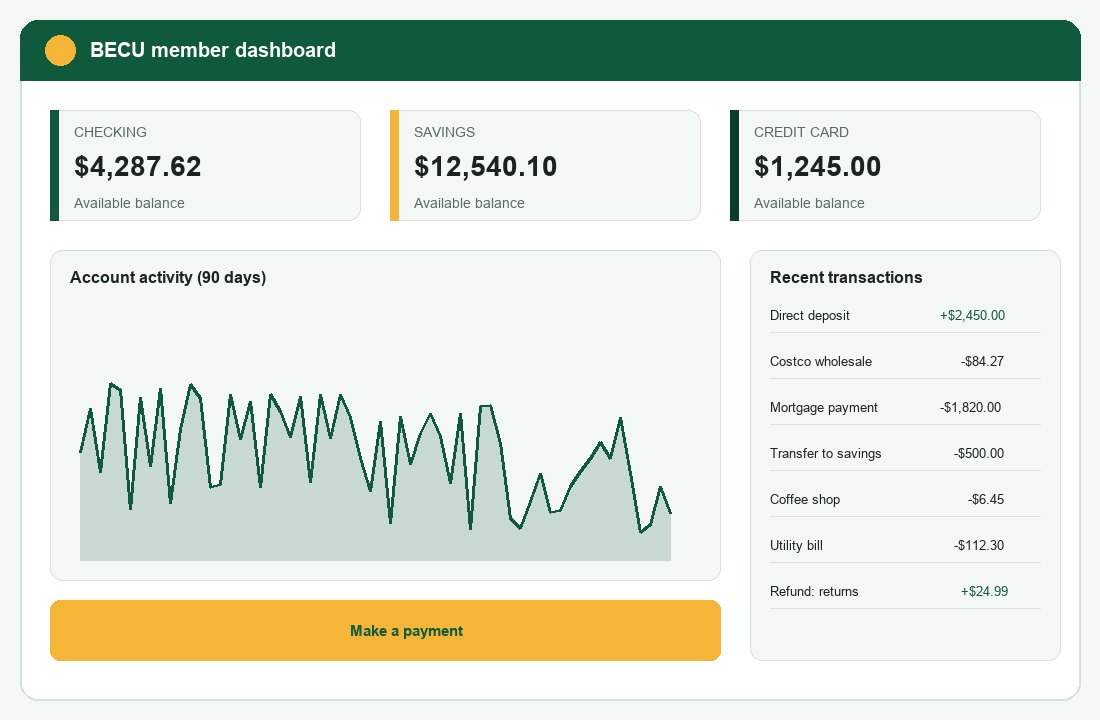
Free checking, savings tiers, mortgages, auto loans, and credit cards built for the individual member household across Washington, Idaho, and South Carolina.
Personal banking →Business checking, business credit cards, SBA-aligned lending, and merchant services for small and mid-size businesses banking with the credit union.
Business banking →Online banking sign-in, the BECU mobile app for iOS and Android, mobile check deposit, transfers, bill pay, and the everyday self-service flows members lean on most.
Digital banking →Branch locator across the Puget Sound region plus shared branches through the CO-OP network, branch hours by location class, and how to reach customer service.
Branches & service →
BECU's personal-banking lineup is built around free checking, tiered savings, and a small but well-tuned set of lending products. Mortgages, auto loans, HELOC, and a member-rewards credit card cover the everyday borrowing needs without the up-sell ladder that bigger national banks lean on. The reference pages on this site walk through how each product sits in the BECU lineup and where the rate disclosures live.
For households moving to BECU from a national bank, the most-asked question is what changes day-to-day. The honest answer is "the small things, mostly". Direct deposits, ACH transfers, and bill pay all behave the same as at any modern bank. The differences show up in the fee structure and in the rates on savings and lending — that is where the credit-union model earns its place. Savings rates and mortgage rates are the right starting points.
BECU's business banking is sized for small and mid-size businesses rather than for enterprise treasury workloads. Business checking, a business credit card, SBA-aligned lending paths, and merchant services together cover the practical needs of a Pacific Northwest small business. The business sign-in path is separate from the personal one and has its own reference page.
For a sole proprietor or a growing LLC, the relevant trade-off versus a national bank is: BECU's hours-and-branch density may be tighter outside the Puget Sound, but the cost of business checking, the rate on business savings, and the underwriting friction for SBA-aligned lending tend to favour the credit union. The reference pages on this site lay out where the pattern holds and where it does not.
BECU's online banking and the BECU mobile app cover the self-service flows members reach for daily — balance checks, transfers, mobile check deposit, bill pay, card controls, and external account linking. The online banking login page on this site walks through the typical sign-in flow; the mobile app page covers the iOS and Android experience.
For a member who lives entirely in the app, the question is what still needs a branch. The honest answer is "very little". Cashier's checks, notarisation, safe-deposit boxes, and a handful of legal-document tasks remain in-branch by design. Everything else clears through the app or the web. The customer service page covers how to escalate when an in-app flow stalls.
A short selection of perspectives from longtime BECU members across the Puget Sound region.
"I switched our household checking to BECU in the mid-2000s and never looked back. The everyday-banking flows are easy, the rates are honest, and the in-branch staff treat members the way credit-union staff are supposed to."
"For aerospace households, BECU is the default and has been for two generations. The mortgage process on our last refinance was the cleanest I have seen at any lender — no padded fees, no last-minute surprises."
"As a healthcare worker on rotating shifts, the mobile-app deposit feature alone saves me a branch trip every payday. The check clears overnight and the app is one of the better-built ones in the credit-union space."
Open the online banking sign-in page, the latest savings or mortgage rates, or the branch finder.
Open online banking guideSeven questions cover the territory most prospective members ask before opening a BECU account.
BECU is a member-owned, not-for-profit credit union headquartered in Tukwila, Washington. It was originally founded in 1935 to serve Boeing employees and their families, and today it is one of the largest credit unions in the United States by membership, with more than 1.5 million members across Washington, Idaho, and South Carolina.
BECU membership is open to people who live, work, worship, or attend school in eligible Washington counties, the entire state of Idaho, and select areas of South Carolina. Family members of existing BECU members can also join regardless of geography. The membership-overview page on this reference site walks through the eligibility paths in plain language.
BECU is a credit union, so deposits are federally insured by the National Credit Union Administration (NCUA) rather than the FDIC. NCUA insurance covers deposits up to $250,000 per share owner per insured credit union, which is the same protection level as FDIC coverage at banks. The NCUA's website publishes the canonical insurance details and member-protection rules.
BECU uses a single routing number across all branches and online channels for ACH transfers, wire instructions, and direct deposits. The routing-number page on this site documents the current number, where it appears on a printed check, and how it differs from the account number for setting up payroll or external transfers.
BECU members sign in to online banking through the upstream BECU website or the BECU mobile app. The online-banking-login page on this reference site explains the typical sign-in flow, what to do if a username or password is lost, how the multi-factor verification step works, and the difference between the personal and business sign-in paths.
BECU operates branches across the Puget Sound region and select cities in Idaho and South Carolina, plus thousands of shared branches through the CO-OP network. The near-me page covers the branch finder for a current location; the locations page covers the full directory by city; and the hours page covers the typical schedule pattern by branch class.
BECU customer service is reachable by phone, in-app secure messaging, online banking message, and at any branch during member service hours. The contact-team and customer-service pages on this site document how each channel typically routes and the expected response window for each contact path. The CFPB publishes broader consumer-finance guidance worth reading alongside any direct support interaction.
BECU is one of the largest credit unions in the United States, and prospective members searching for product details, branch hours, or sign-in flows benefit from a single organised reference that does not bury the answer behind marketing copy.
This site is an independent reader-first reference on BECU. It is not the upstream credit-union corporate site, and it does not host transactions, account access, or any sign-in flow. It documents how the BECU products work in everyday use — how the checking and savings tiers fit together, how the mortgage process plays out, what the online banking and mobile app cover, where the branch network sits, and how to reach customer service when an in-app flow stalls. The pages are written for the member side of the relationship rather than the marketing side.
Three reader profiles dominate. The first is the everyday BECU member trying to confirm one specific fact — the routing number for a payroll setup, the customer-service phone number for a card-replacement question, the branch hours for a Saturday errand. They land on a page, find the answer in a paragraph or a table, and leave. We try to put the answer above the fold. The second profile is the prospective member evaluating BECU against a national bank or a competitor credit union; they want a reference that compares product structure honestly without a sales pitch. The third profile is the small-business owner weighing BECU's business banking against a community bank or a national alternative.
We do not host BECU online banking. We do not proxy any sign-in flow or any account-management surface. Where a topic touches financial-safety advice, we link out to authoritative public sources — the NCUA for credit-union insurance, the Consumer Financial Protection Bureau for general consumer-finance guidance, the Federal Trade Commission for fraud reporting — rather than to commercial third parties.
A short orientation for readers who have never been a credit-union member before. The differences are real but small in everyday use.
A credit union is a member-owned, not-for-profit financial cooperative. The ownership structure is the most important part: at BECU, every member is a partial owner of the institution, and any operational surplus the credit union runs is returned to members through better rates and lower fees rather than distributed to outside shareholders. That structural difference is why credit unions tend to publish higher savings rates and lower lending rates than comparable national banks, even after adjusting for institution size and risk profile.
The trade-off historically was branch density and product breadth. National banks have larger branch networks and offer products credit unions typically do not — international wire networks, sophisticated treasury services, white-glove wealth management. For most everyday members, those trade-offs do not bind. Direct deposit, mortgage origination, debit and credit cards, online banking, and the standard self-service flows all work identically. The shared-branching CO-OP network closes the geographic gap for credit-union members travelling outside their home institution's branch network.
For a procurement-style framing — "should our household move primary banking to BECU" — the practical answer turns on three questions. Does the member meet the eligibility criteria (yes if they live, work, worship, or attend school in eligible WA counties, anywhere in Idaho, or specific SC areas; or are a family member of an existing member). Does the typical-use rate advantage on savings and lending outweigh any specific national-bank product the household relies on. And does the branch network cover the household's daily geography — the answer is almost always yes inside the Puget Sound, and increasingly yes elsewhere through CO-OP shared branching.
Three topical silos for the substantive content (Personal / Business / Digital), six generic-information hubs for the editorial side, five keyword-landing pages, and one privacy-policy.
The first silo is Personal banking. It covers the BECU checking accounts, the savings rates page, mortgage rates, the credit card lineup, auto loans, and the HELOC product. Each of those pages stands alone for a search reader and cross-links so a household working through a financial decision can keep adjacent topics one click away.
The second silo is Business banking. It covers the business banking sign-in path, business checking, the business credit card, SBA-aligned lending, and merchant services. Smaller and tighter than the personal silo because the BECU business surface is also smaller and tighter than the personal one — the credit union is honest about which businesses fit its sweet spot.
The third silo is Digital & service. It covers the online banking sign-in, the mobile app, the make-a-payment surface, the routing number, the customer-service phone number, and the typical branch hours pattern. This is the silo where day-to-day members spend most of their reference reading.
Surrounding the silos are six generic-information hubs renamed for site-uniqueness (membership-overview, fraud-prevention, member-resources, contact-team, login-walkthrough, financial-educator-bio). Five keyword-landing pages catch specific high-intent searches: official-site (clarifying that this is the independent reference, not the upstream BECU site), becu-org-login (the dot-form sign-in keyword distinct from the broader online-banking-login), near-me (the geo-anchored branch finder), locations (the full branch directory), and customer-service (the contact-method overview). A privacy policy rounds out the set.
That structure is not arbitrary. It mirrors how BECU topics actually cluster in search query data — banking-product questions are one cluster, business-banking questions are another, digital and self-service questions are the third, and branch / service questions are the fourth — and lets each page speak to one clear reader intent without bleeding into the others. The numbered FAQ section above covers the seven highest-volume questions readers ask before they go any deeper into the site.
Three reading patterns work well across the site, depending on whether a reader needs a quick fact, a product comparison, or a step-by-step walkthrough.
For a quick-fact reader, the right pattern is to use the keyword-topic navigation strip below the FAQ. Every BECU keyword in the cluster has its own dedicated page, and the strip is the fastest way to land on the right one. The BECU routing number, BECU phone number, BECU branch hours, and BECU customer service direct lookups all land on focused single-purpose pages within one click.
For a comparison reader weighing a switch from a national bank to BECU, the right pattern is to read the personal-banking silo end-to-end. The BECU savings rates page, the BECU mortgage rates page, and the BECU credit card page each include rate-class tables and the kind of context a household needs before committing to a primary-banking move. Where the reference is silent on a current rate, the upstream BECU site is the canonical source for the live number.
For a step-by-step reader trying to complete a task, the right pattern is to use the digital silo. The BECU online banking login, BECU mobile app, and BECU make-a-payment pages each walk through the practical flow in order, with screenshots replaced by data tables that document each step's expected outcome.